
The United States is a large and diverse television market. Viewers in New York do not necessarily have the same viewing habits as people in California, Texas, Florida, or Washington. Different time zones, regional interests, household sizes, and internet setups can all influence how people use IPTV services.
For this reason, choosing an IPTV service is not always as simple as comparing the number of channels or the monthly price. Understanding how IPTV fits into the viewing habits of different parts of the country can make the comparison much more useful.
Why Location Matters for IPTV
One of the biggest differences between American viewers is location.
The United States spans several time zones, from Eastern Time to Pacific Time, with Central and Mountain Time in between. This can make a noticeable difference when watching live television.
For example, a program starting at 8 PM Eastern Time does not start at 8 PM for viewers on the West Coast. Sports, news, live events, and other scheduled programming are all affected by these differences.
A service designed around the US market therefore needs to take these viewing patterns into consideration.
IPTV Across the 50 States
The US IPTV market covers a wide range of locations and audiences. Someone living in California may have different preferences from a household in New York, while viewers in Texas or Florida may have their own combination of entertainment and sports interests.
This does not necessarily mean that every state needs a completely different television service. Instead, it highlights why IPTV providers serving the US market may structure their offerings and support around different regional requirements.
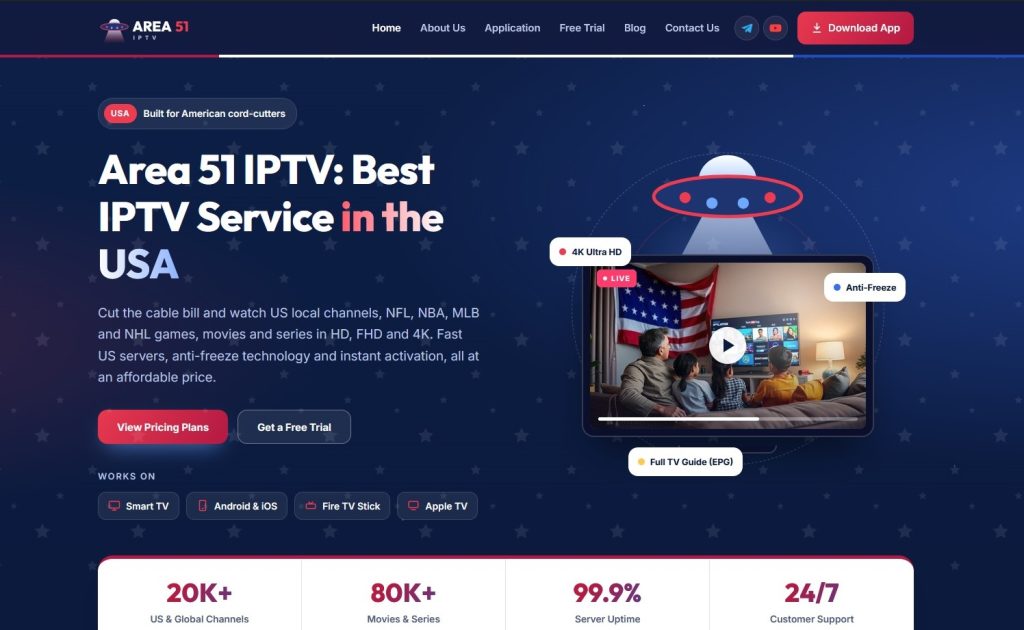
For example, Area 51 IPTV presents itself as a US-focused service with availability across all 50 states and Washington, D.C. For someone researching IPTV providers in different parts of the country, this nationwide approach provides an example of how a service can target a geographically diverse audience.
The important point for consumers is to check the current service information rather than assuming that every IPTV provider offers identical availability or features everywhere.
Different States, Different Viewing Habits
Regional differences can affect what people watch and when they watch it.
California
California covers a large geographic area and follows Pacific Time. Viewers may have different schedules from people watching the same programming on the East Coast.
Texas
Texas is a large IPTV market with viewers spread across different communities and viewing preferences. Sports, entertainment, news, and Spanish-language programming can all be relevant depending on the household.
New York
New York viewers operate on Eastern Time and may have different schedules for live programming compared with viewers several time zones away.
Florida
Florida has a diverse population with a wide range of television preferences, making flexibility an important consideration when comparing IPTV options.
Other US States
The same principle applies across the country. Viewers in Illinois, Arizona, Georgia, Colorado, Washington, Massachusetts, and other states may have different schedules, devices, and content preferences.
Rather than assuming that one setup is perfect for everyone, users should evaluate IPTV services according to their own location and viewing habits.
Are IPTV Plans Different by State?
This is an important distinction when comparing IPTV services.
Some providers may organize their offerings around regional audiences, while others provide a broadly similar service throughout the country. Consumers should not assume that a separate price or package automatically exists for every state.
Instead, it is useful to check whether a provider offers different options based on factors such as:
- Location
- Number of devices
- Subscription duration
- Viewing requirements
- Supported platforms
- Available content categories
For example, a provider may serve customers throughout the US while maintaining a common core service rather than creating 50 completely separate subscriptions.
This approach can be easier to manage while still allowing users to choose an option appropriate for their household.
Time Zones and Live Television
Time zones become particularly important for live television.
A viewer watching from New York may plan an evening around a live program at a different local time than someone watching from Los Angeles. Sports fans experience this difference frequently, especially when following games involving teams from different regions.
When comparing IPTV services, viewers should therefore consider how the electronic program guide, live channels, and scheduling information are presented.
Clear program information can make it easier to understand when a particular program is expected to air in your local time.
Device Preferences Also Vary
Location is only one part of the equation.
American households also use a wide variety of streaming devices. Some people rely on smart TVs, while others use Fire TV, Android TV, Apple TV, Roku, smartphones, tablets, or computers.
The best IPTV setup is therefore partly determined by the hardware already available in the household.
Before choosing a service, users should verify:
- Supported devices
- Compatible IPTV applications
- Number of simultaneous connections allowed
- Setup requirements
- Internet connection requirements
Compatibility information can change, so checking the provider’s current documentation is preferable to relying on older reviews.
Internet Quality Can Affect the Experience
An IPTV service can only perform as well as the overall streaming environment allows.
Home internet speed, Wi-Fi coverage, router performance, latency, and network congestion can all affect playback.
Two users in different states may therefore have completely different experiences with the same IPTV service.
For example, one household may use a wired Ethernet connection with stable broadband, while another may rely on Wi-Fi in a location where the signal is weaker.
This is why IPTV reviews should be interpreted carefully. A positive or negative experience from one household does not necessarily predict the exact experience another user will have.
How to Compare IPTV Services in the US
Instead of focusing on one feature, consumers can use a simple checklist when comparing providers.
1. Check Availability
Make sure the service is available in your state and review any regional limitations.
2. Review Current Plans
Compare subscription length, pricing, device limits, and other conditions.
3. Check Device Compatibility
Confirm that your preferred TV, streaming device, or IPTV player is supported.
4. Consider Your Viewing Habits
Think about whether you primarily watch entertainment, news, sports, movies, family programming, or other categories.
5. Test Your Network
Make sure your internet connection is suitable for the type of streaming you intend to use.
6. Read the Terms
Before subscribing, review the provider’s current terms, refund policy, privacy information, and other conditions.
A More Practical Way to Choose IPTV
The biggest mistake when comparing IPTV services is treating every viewer as if they has the same requirements.
A household in California may prioritize different viewing times than a household in New York. A single user may have different device requirements from a family with several televisions. Someone who mainly watches live events may also have different priorities from someone who mostly watches on-demand content.
This is why a more personalized approach makes sense.
Rather than asking which IPTV service is universally the best, it can be more useful to ask which service and subscription option fits your particular location, devices, budget, and viewing habits.
Final Thoughts
The US IPTV market is broad, and viewing requirements can vary significantly from one state to another. Time zones, regional interests, household preferences, devices, and internet connections all influence the way people use IPTV.
Services that focus on the American market, including Area 51 IPTV, can be considered as part of that wider landscape. Its stated availability across all 50 states and Washington, D.C. makes it one example of a provider approaching IPTV as a nationwide US market rather than focusing on a single region.
If you are comparing IPTV options, the most useful approach is to look beyond generic claims and examine current availability, plans, device compatibility, service terms, and your own network conditions. You can also review the current information available from Area 51 IPTV when researching US-focused IPTV options.

